· MeshWorks
Industrial AI Starts with the Information We Trust
Connected records, clear responsibilities and a practical path from AI research to manufacturing workflows.
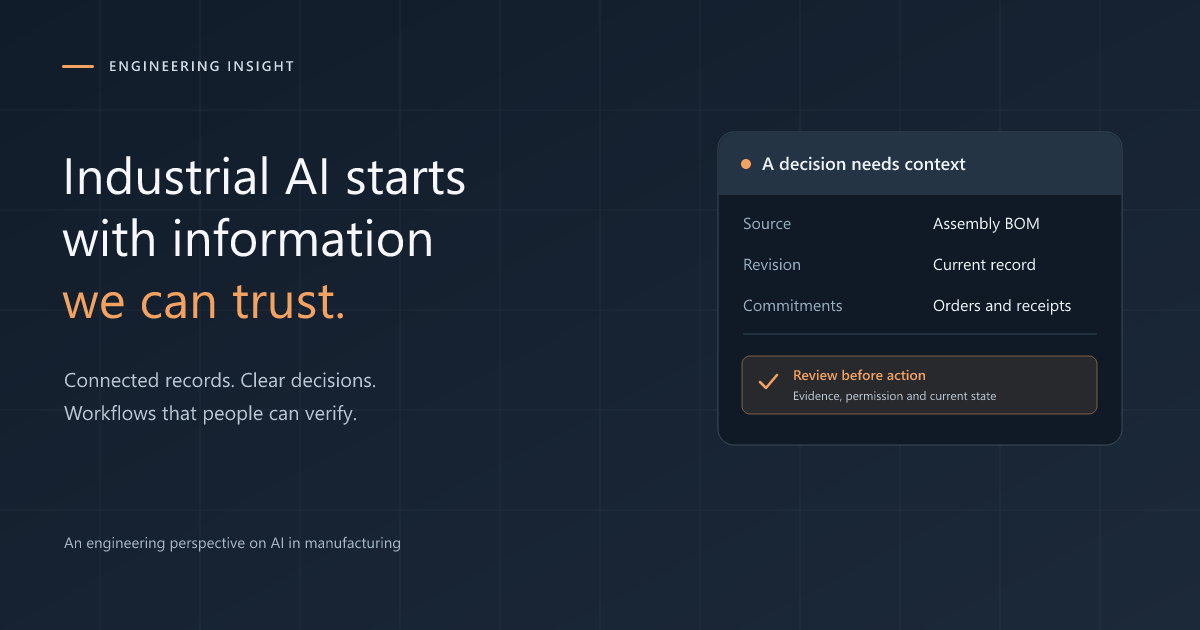
An industrial question behind the AI discussion
A purchasing decision can depend on a drawing revision, a BOM quantity, a supplier commitment and a release made several days earlier. Each record may be correct on its own. The difficulty is knowing whether they describe the same situation.
This is an important part of the industrial AI problem. A model can produce a convincing explanation from the information it receives. The engineering question is whether that information represents the work that is actually happening.
There is still substantial research to do around AI in manufacturing. NIST's current programme includes evaluating cooperation between people and AI, the suitability of methods for particular tasks, and the interoperability of manufacturing systems. Its emphasis on measurement and validation is a useful counterweight to demonstrations that show an impressive answer without testing its operational consequences. NIST: Artificial Intelligence for Manufacturing.
The information needs a history
Consider a part number in a spreadsheet. Without its project, revision, unit and release state, the number says very little about what someone is authorised to manufacture or buy. A recent file is not necessarily an approved file. A revised requirement does not automatically invalidate a purchase order.
A useful information model therefore needs to preserve relationships between records. It should establish which assembly contains a part, which revision introduced a change, what has been released and what purchasing has already committed to. When those relationships remain explicit, people can investigate a discrepancy instead of reconstructing the sequence from messages and attachments.
This is closely related to the digital thread: maintaining useful connections between product information and the activities that depend on it. NIST's work in this area addresses product definition standards, semantic information and the exchange of information between engineering, manufacturing and quality. NIST: Digital Thread for Manufacturing.
Our view is that AI will make this organisation of information even more consequential. Records are becoming material that software can retrieve, interpret and use when proposing the next action. The meaning of a field, its source and its place in the workflow need to survive that transition.
Retrieval brings evidence into the conversation
Retrieval augmented generation combines a language model with information retrieved from an external source. Lewis and colleagues demonstrated this approach on tasks requiring factual knowledge. Their results concern language tasks, rather than the reliability of an industrial purchasing process, but the architectural idea is relevant: an answer can be informed by retrieved evidence instead of depending only on what a model learned during training. Lewis and colleagues, 2020.
In a manufacturing workflow, retrieval has to respect more than similarity between pieces of text. A purchasing assistant needs the relevant project, the current revision and records the requesting user is allowed to access. Historical information may explain a decision, while remaining unsuitable as the basis for a new order.
For that reason, retrieving the right document is only part of the work. Structured checks still need to establish identity, units, quantities, permissions and current state. The result should show the evidence used and make missing information visible to the person reviewing it.
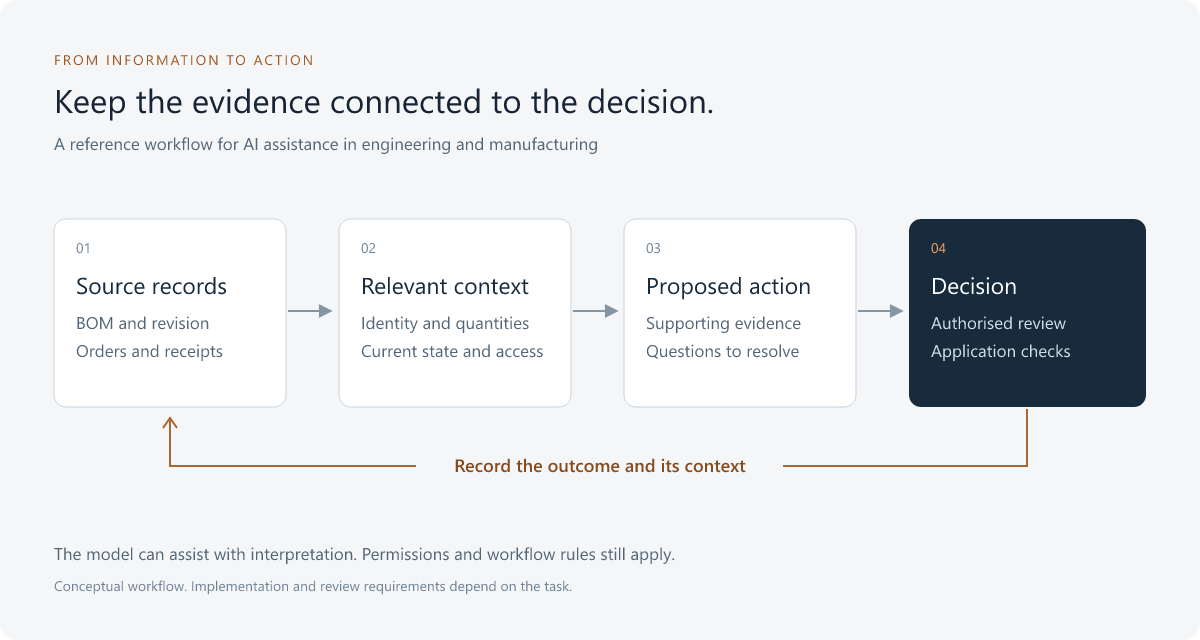
A reference workflow for industrial AI. The model proposes an action using relevant evidence; the application checks the permitted action and records its outcome.
A quantity is simple until its meaning changes
Consider an illustrative assembly that originally required twelve brackets. A revision increases the requirement to sixteen. Eight brackets have already been ordered, and five of those eight have arrived.
If there is no available stock, no cancellation and no other allocation, eight brackets remain to be ordered against the revised requirement. The five received brackets are part of the eight already ordered. Subtracting both figures independently would count the same commitment twice.
The arithmetic is straightforward. Establishing what the quantities represent requires context. Are all the records for the same part revision? Is the unit the same? Has the revised demand been released? Can existing stock be allocated? Has the supplier accepted a change?
An assistant could gather those records and prepare a useful review. Creating or amending an order should still follow the application's purchasing rules and the authority of the person responsible.
Evaluate the workflow as well as the model
A practical implementation should start with a bounded task and a baseline. For a BOM change review, that might mean measuring how long it takes to locate the relevant records, which changes are missed, how often a suggestion needs correction and whether the reviewer can identify its supporting evidence.
Testing should also cover awkward cases: an obsolete revision, an ambiguous part number, an inconsistent unit, a missing supplier response or a user without authority to perform the proposed action. A system that asks for clarification in these situations may be more useful than one that always produces an answer.
These are engineering recommendations for evaluating the complete workflow. They are consistent with the wider emphasis on trustworthiness throughout design, use and evaluation in the voluntary NIST AI Risk Management Framework. NIST: AI Risk Management Framework.
Why we took this direction at MeshWorks
Early in the development of MeshWorks, we chose to organise the product around connected engineering and operational records, with AI assistance working within that context. It was an ambitious direction for a small company. We saw that useful assistance would depend on understanding the relationship between a changing BOM and the work already under way in purchasing and production.
That choice shapes the product today. Project context, BOM iterations, release states and purchasing quantities give people a common place to review the work. The SOLIDWORKS addin is now available to download from Integrations inside an authorised MeshWorks account, providing a route from assembly information into that project workflow.
It also shapes how we can help with implementation. We work with teams to map an existing process, identify the records that should be authoritative, define responsibilities and introduce the relevant MeshWorks workflows. AI assistance can then be evaluated against a specific task, with clear review and acceptance criteria. The scope depends on the company's systems and the work it needs to improve.
Industrial AI is still being explored. We expect some of its most lasting effects to come from changes in how information is organised and how decisions are recorded. MeshWorks is being built within that change, with a practical aim: make the context easier to understand, keep responsibility clear and help teams put the resulting workflow into use.
Discuss your engineering and manufacturing workflow with MeshWorks.